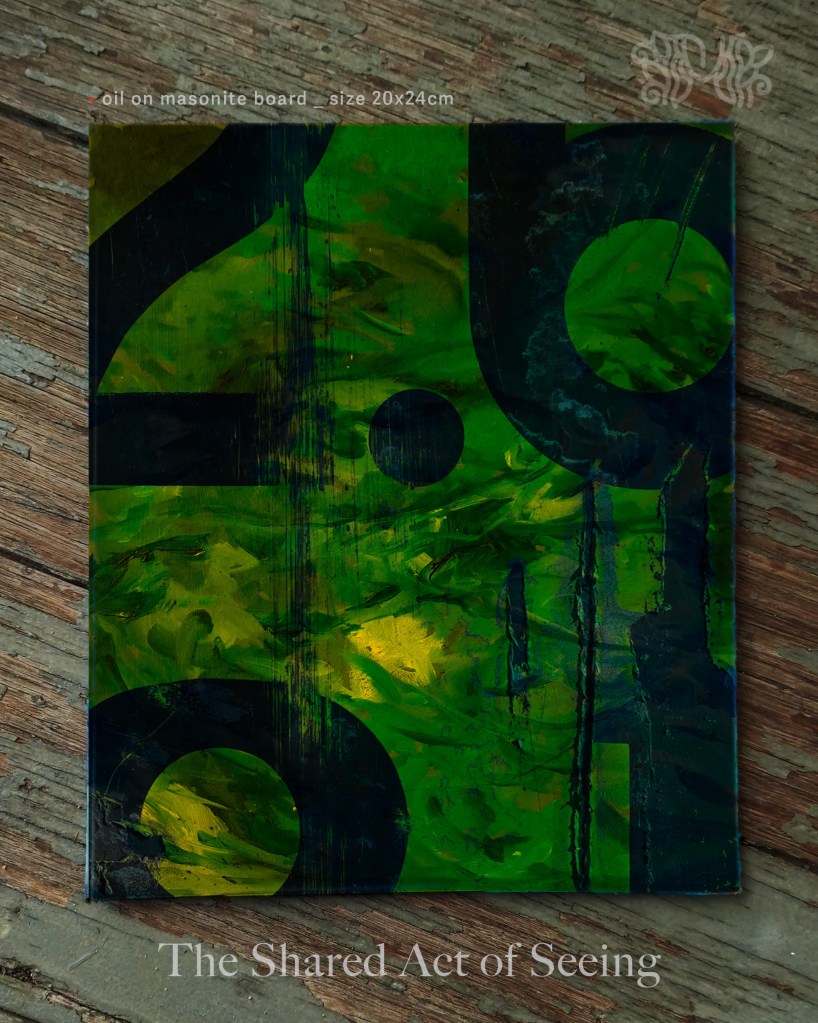
Perception is not just a one-way process. When we look at something, especially a work of art, it is not only the image that speaks to us. We bring our own thoughts, feelings, and experiences into what we see. What we notice, how we react, and the meaning we find depend as much on who we are as on what we are looking at.
This is why art is so powerful. A single line on a page, a smudge of charcoal, or a brushstroke of paint can hold very different meanings for different people. For one viewer, it may evoke a sense of calmness; for another, it may stir a memory of loss or joy. The same mark exists for everyone, but it comes alive in unique ways depending on the person looking at it.
Every image, even the simplest one, can hold more meaning than the artist first imagined. Once a mark is made, it starts its own journey. It is no longer just a line, a color, or a shape. It becomes a point of contact between the artist and the viewer. In that meeting, something new appears: interpretation.
This is what makes visual art special. It does not just wait to be understood; it connects with each person who looks at it. The viewer brings it to life, adding layers of meaning that are always changing. You might think of an artwork as a stage. The artist sets it up with lines, colors, and shapes, but the viewer brings their own stories, memories, and feelings to fill that space.
As artists, this can be both humbling and liberating. We can control what we put into the work—the choice of materials, the structure, the colors, the mood. But we cannot control how others will respond. Two people may stand before the same painting and walk away with entirely different experiences. Neither interpretation is “wrong.” Each is valid because each arises from a personal engagement with the work.
For the viewer, this means that looking at art is not passive. It is more than just seeing what is there. It is like having a conversation. Your life, your feelings, and even your memories all shape what you see. When you look at art, you are not just taking in meaning; you are also adding your own.
This reciprocal process is what keeps art alive across time and culture. A centuries-old painting can still speak to us today because we bring ourselves to it. Every generation, every individual, finds new significance in the same image.
So next time you look at a work of art, take a moment to notice what is happening. The image is not just showing itself to you; you are helping to bring it to life. Where what you see meets what you feel, that is where art really lives.
 Art Rabbithole
Leave a comment